OEM Device Control · Solution
Elmes Thermal Process Controller (sintering, drying, heat treatment)
A furnace controller that runs programmed temperature profiles safely and resumes where it left off.
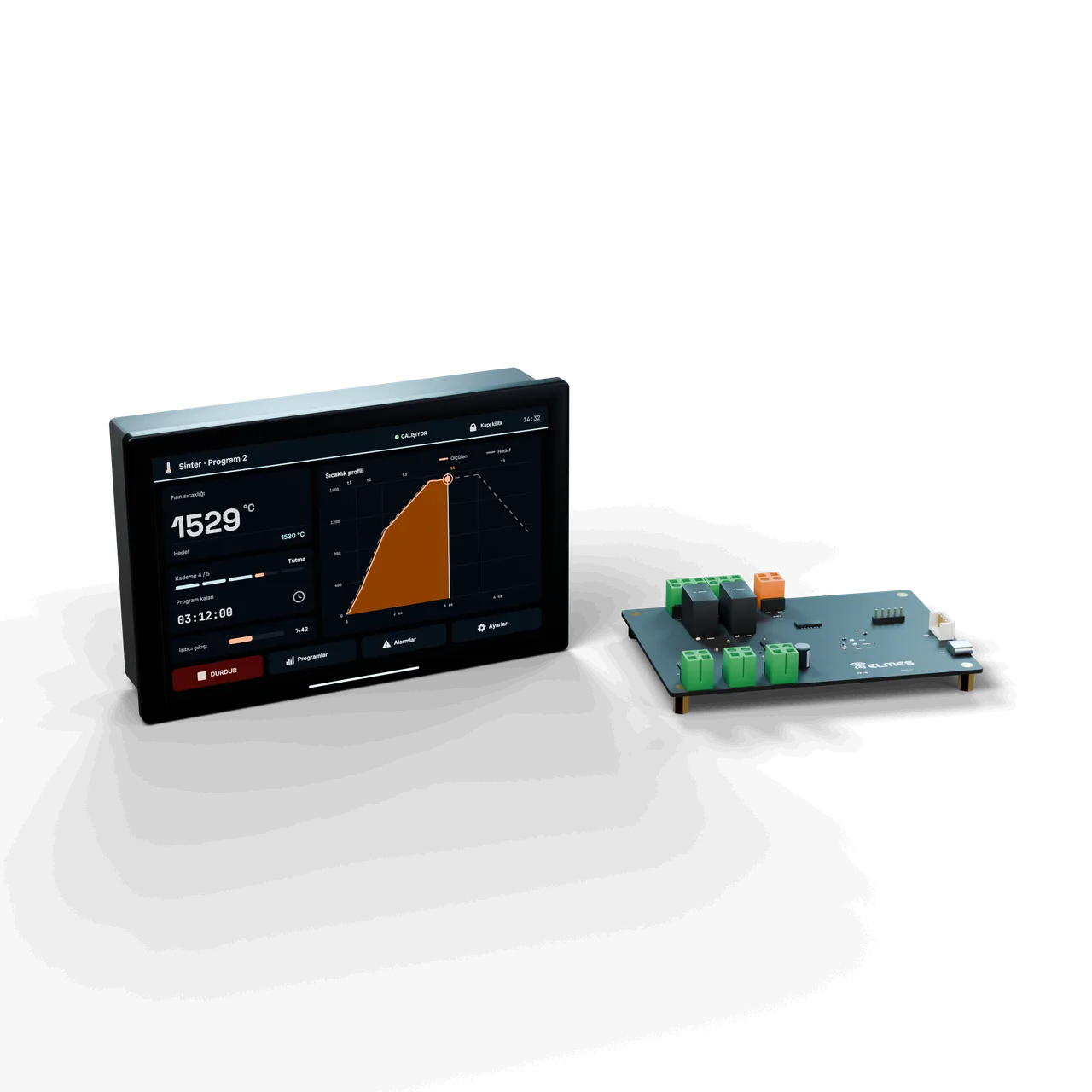
Overview
The problem. Makers of sintering, drying and heat-treatment furnaces mostly combine an off-the-shelf PID controller, a separate program unit and separate door/safety logic. The interface is fragmented, profile programming is hard, a power cut restarts the program from the beginning, and for heaters such as MoSi₂ that have low resistance when cold, transformer current protection is handled outside the controller. In zirconia sintering, a deviation of a few degrees at the 1530 °C hold step directly affects product quality.
The solution. The Elmes Thermal Process Controller brings temperature measurement (MCP9600, type S thermocouple, 18-bit), PID + dead-time compensation, step programs (5 steps, 4 programs; t3 user-adjustable in one of them), a power ceiling (transformer protection at low temperature), output ramping, door lock, fan relay, run-hour counter and a 7" touch HMI together on one board. After a STOP or a blown fuse, START positions the profile at the right step and time based on the furnace temperature (“resume where it left off”). Application-specific protections, such as a forbidden output band (80–84 %) against transformer resonance seen in the field, are added as parameters.
Platform advantage. The same software framework (programs/recipes, alarms, logging, PID, HMI) is shared with the other applications on the OEM Device Control Platform; for drying or heat treatment, only the sensor type, output stage and profile scheme change.
| Off-the-shelf PID + separate program unit | PLC + HMI | Elmes Thermal Process Controller | |
|---|---|---|---|
| Profile program | Limited, separate device | Project-specific software | 5 steps × 4 programs, curve on the HMI |
| Dead-time compensation / power ceiling | None / external | Must be programmed | Built in, parameterized |
| Resume where it left off | No | Must be programmed | Built in |
| Door lock / cool-down logic | External relay | Must be programmed | Built in |
| Cost (OEM series) | Medium | High | Low to medium |
| Customization | None | In every project | Parameters/HMI through NRE |
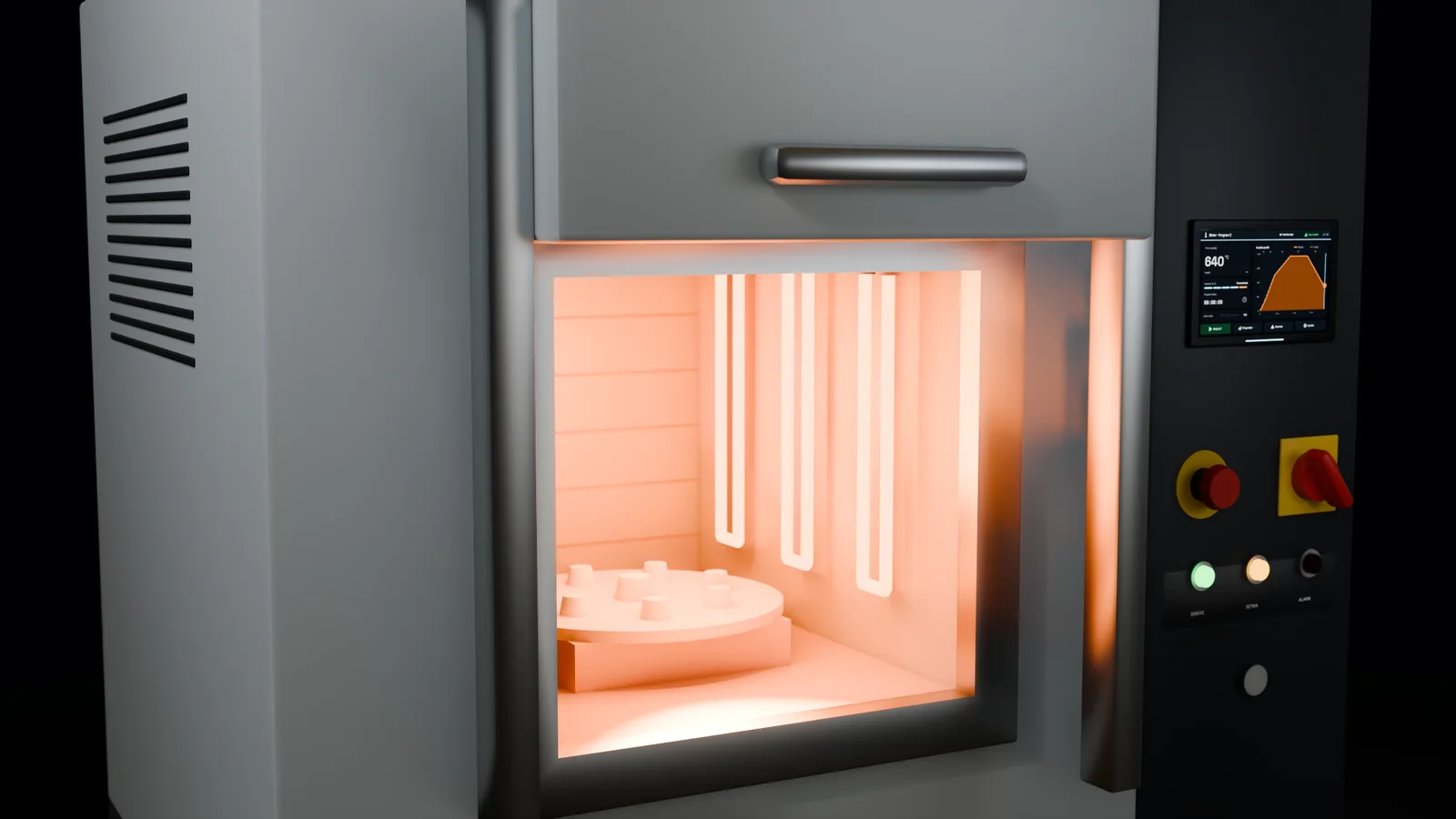
This product is in development or field testing. Contact us for technical information, pilot use and a preliminary quotation.
Features
- Power ceiling (transformer protection): MoSi₂ heaters have low resistance when cold; the output is limited according to the temperature band.
- Dead-time compensation: a 30 s look-ahead from a 16 s trend offsets filter lag.
- Forbidden output band: the power band where transformer resonance was observed (80–84 %) is skipped with hysteresis.
- Resume where it left off: after a STOP or blown fuse, the right step and time in the profile are found from the furnace temperature.
- Door safety: the lock engages at START; the door opens only below the set safety temperature; the lift-door variant (TP-S-L) adds a motor drive and a two-stage START.
- Run-hour and program counter: service/warranty tracking on the HMI settings page.
- Simulation mode (debug): end-to-end program testing on the bench with a qualitative furnace model, including fault injection.
- Parameter-based customization: PID, ceiling, ramp, cut-off, izone, TMAX and runaway thresholds are set from the console and saved.
- TargetExpansion: multi-zone control, PT100/type K inputs, Modbus RTU, Wi-Fi monitoring, program library (recipes) and process logging.
Variants
| Model code | Application | Sensor | Output | Door | Status | Request information |
|---|---|---|---|---|---|---|
| TP-S | Sintering (1530–1700 °C, MoSi₂ heater) | Type S thermocouple (type B planned) | 0–10 V → SSR, transformer current protection | Electric lock | In field testing | Request information: TP-S |
| TP-S-L | Sintering, lift door | Type S | 0–10 V SSR | Lift motor + lock | Existing variant; moving to the new platform | Request information: TP-S-L |
| TP-DTarget | Drying (≤ 300 °C) | Type K / PT100 | Relay or SSR, fan | Optional | Planned | Request information: TP-D |
| TP-HTarget | Heat treatment (≤ 1200 °C) | Type K / N | SSR, multi-zone | Optional | Planned | Request information: TP-H |
| HMI | Display options: 7" DWIN T5L 800×480 (current); 4.3" DWIN or DiscOS | — | — | — | 4.3" and DiscOS options planned | Request information: HMI |
Specifications
Values marked “Target” are design targets, next-generation values or chip-vendor data; they are updated as measurement and certification are completed.
| Temperature input | MCP9600, type S thermocouple, 18-bit, I²C; digital filter (EMA, ~41 s) |
|---|---|
| Measurement range | −50…1850 °C valid range; TMAX default 1650 °C |
| Heater output | PWM ≈ 9.8 kHz → ULN → 0–10 V → SSR; 0–100 % |
|---|---|
| Relay outputs | Door lock, fan |
| Extended outputs | 4 relays + 2 SSR driversTarget |
| Digital inputs | Door status |
| Extended inputs | 4 DI (door, emergency stop, thermal overload)Target |
| Programs | 4 programs × 5 steps; sample profile: t1 30 min 0→300 °C, t2 60 min →1000 °C, t3 variable →1530 °C, t4 120 min hold, t5 120 min →700 °C; in program 3, t3 is user-adjustable (1–720 min) |
|---|---|
| Control | PID (default Kp 0.05 / Ki 0.0005 / Kd 1.5) + dead-time compensation + power ceiling + 2 %/s ramp + cut-off + 80–84 % forbidden band |
| Resume | Positions the profile from the furnace temperature (PV) |
| Alarms | Sensor fault, over-temperature, runaway; HMI error page |
| Logging | CSV telemetry on the USB console (debug); 10-hour curve on the HMI |
| Process log | Persistent process log + USB/Wi-Fi exportTarget |
| Run-hour counter | RUN minutes + completed program count; flash ping-pong storage, ~85,000-hour life |
| Hold stability (simulation) | 1528.6–1530.0 °C; overshoot ≤ 6.4 °C (τ 1200–2400 s) |
|---|---|
| Safety | IWDG ~4 s, EmergencyOff, configuration range validation, configuration version migration (v1→v3) |
| Door-open safety temperature | 150–700 °C, adjustable |
| MCU | STM32F070CB, 48 MHz |
|---|---|
| New platform board | OEM Device Control Platform board (STM32G0)Target |
| HMI | 7" DWIN T5L touchscreen, 800×480 |
|---|---|
| Service interface | USB-CDC console (debug build), SWD |
| Firmware update | Via SWD; no OTA |
| OTA | Wi-Fi/USB updates through the platform bootloaderTarget |
| Board supply | 5 V / 3.3 V |
|---|---|
| OEM supply input | 24 VDCTarget |
| Warranty | 2 yearsTarget |
|---|---|
| Service | Ankara, Türkiye |
Applications
- Zirconia sintering furnaces
- Technical ceramics sintering
- Drying ovens
- Heat-treatment furnaces
- Laboratory ashing furnaces
- Programmable temperature control
Applications: dental-lab zirconia sintering furnaces (1530 °C), technical ceramics sintering (≤ 1700 °C, MoSi₂), drying ovens (paint, food, laboratory), heat-treatment furnaces (annealing, tempering), laboratory ashing furnaces and general programmable temperature control.
Industries: furnace manufacturers, dental lab equipment suppliers, ceramics, metal heat treatment, laboratory instrument makers.
Customization: PID and protection parameters are set from the console; the HMI and output stage are adapted to the furnace through NRE.
Compliance & documentation
The device is in field testing; CE documentation and the manual set are being prepared according to the plan below.
- TargetCE — LVD / EMC
- TargetEN 60519 furnace safety note
- TargetOperator manual
- TargetParameter / service manual (console commands)Partially complete
- TargetWiring diagram
Frequently asked questions
Which thermocouples are supported?
Type S today (MCP9600). Support for types K, N, B and PT100 through customization is planned.
What is the maximum temperature?
It depends on the application; the sintering version runs a 1530 °C profile with 1700 °C heaters, and TMAX is 1650 °C (adjustable).
Does the program restart from the beginning after a power cut?
No; at START it resumes from the step and time in the profile that match the furnace temperature.
How many programs are there?
4 programs × 5 steps; in one program, t3 is user-adjustable. A recipe library is planned.
When can the door be opened?
At the end of cool-down, once the temperature is below the set safety temperature (150–700 °C).
Can it be adapted to my furnace?
Yes; PID and protection parameters are set from the console, and the HMI and output stage are adapted through NRE.
Is remote monitoring available?
Not today; it is planned through the Wi-Fi module of the OEM Device Control Platform.
What about warranty and service?
A 2-year warranty is planned; service is in Ankara.
Get information about this product
Our engineering team replies within 24 hours.
Related products
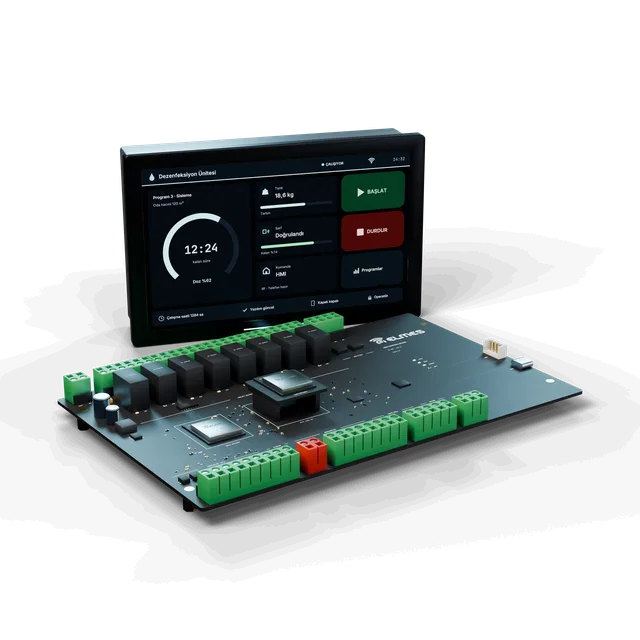 OEM Device Control
Elmes OEM Device Control Platform
Your device's electronics are ready — you focus on the machine.
View details: Elmes OEM Device Control Platform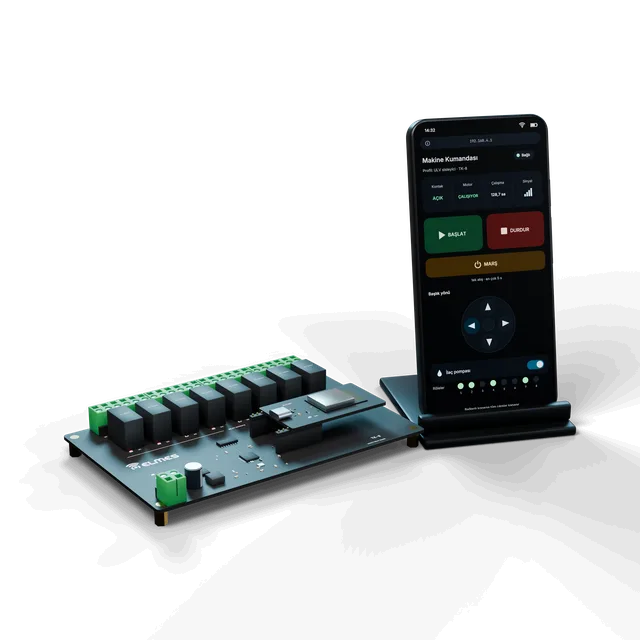 Coming soonOEM Device Control
Smartphone Machine Remote Control
Put the remote in your pocket: run the machine from your phone, safely and wirelessly.
View details: Smartphone Machine Remote Control