RF & Wireless Systems · Hardware
Wireless Call Button Platform
One button hardware for every call scenario.
Overview
The problem. Call and alarm buttons all do the same job: someone presses, someone somewhere is notified. Yet each application is sold as a separate product — waiter button, panic button, taxi button, fire button — and most are short-range (100–200 m), one-way, unencrypted 433 MHz "remote" circuits with unknown battery life. They do not reach from the beach to the kitchen, from the neighborhood to the taxi stand, or from the factory yard to the guard hut; nobody knows whether a press was received; and two systems on the same site trigger each other.
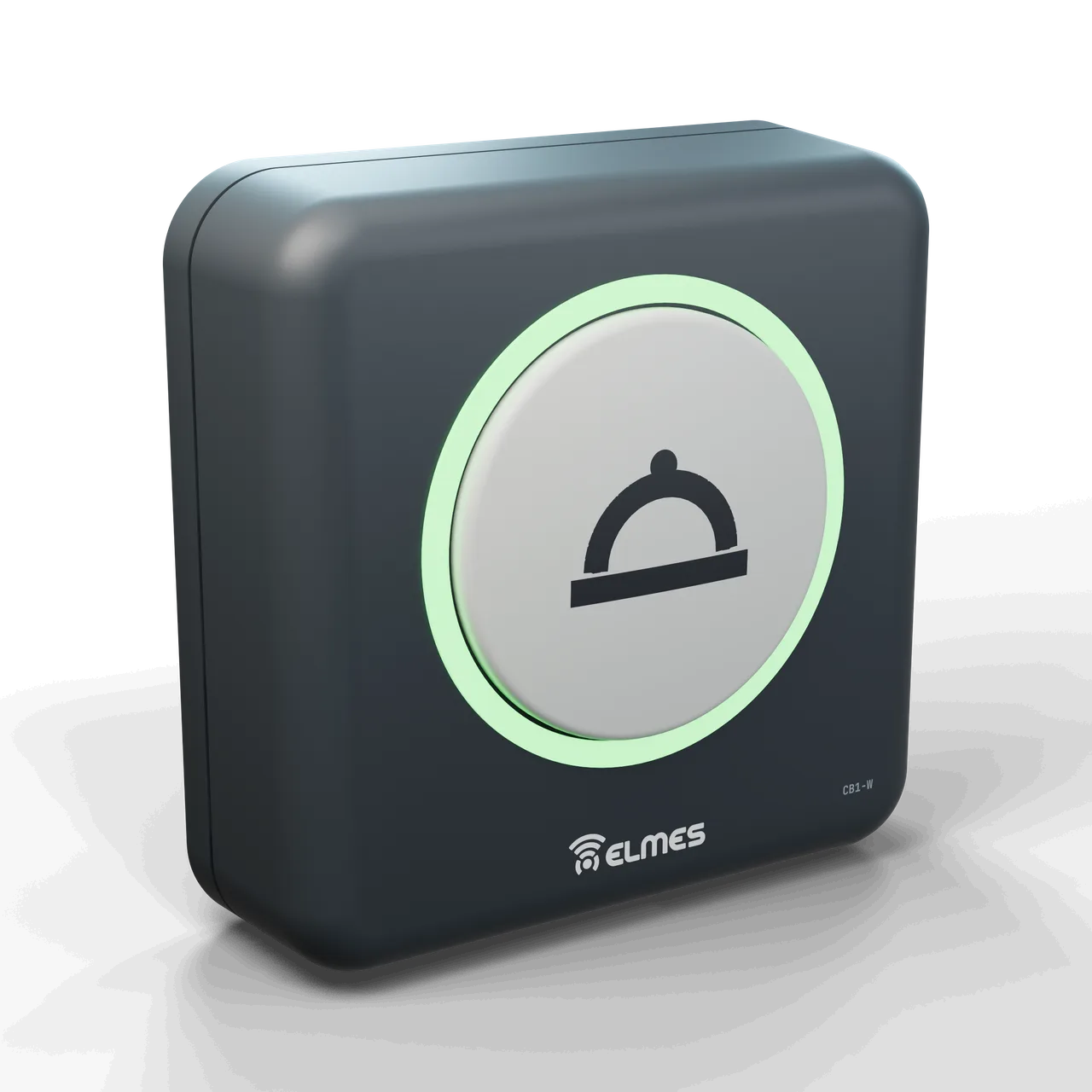
The solution. The platform puts a battery-powered LoRa node (EM-G0L-433-LP) into a button housing. Each press sends an encrypted packet with the button ID, button number, battery status and a counter; when the central unit or receiver returns an acknowledgment (ACK), the LED on the button turns green (two-way operation is targeted). The firmware profile defines what a press means: waiter / bill / cancel, attack / fire / patrol, taxi call / cancel, break-glass alarm + tamper.
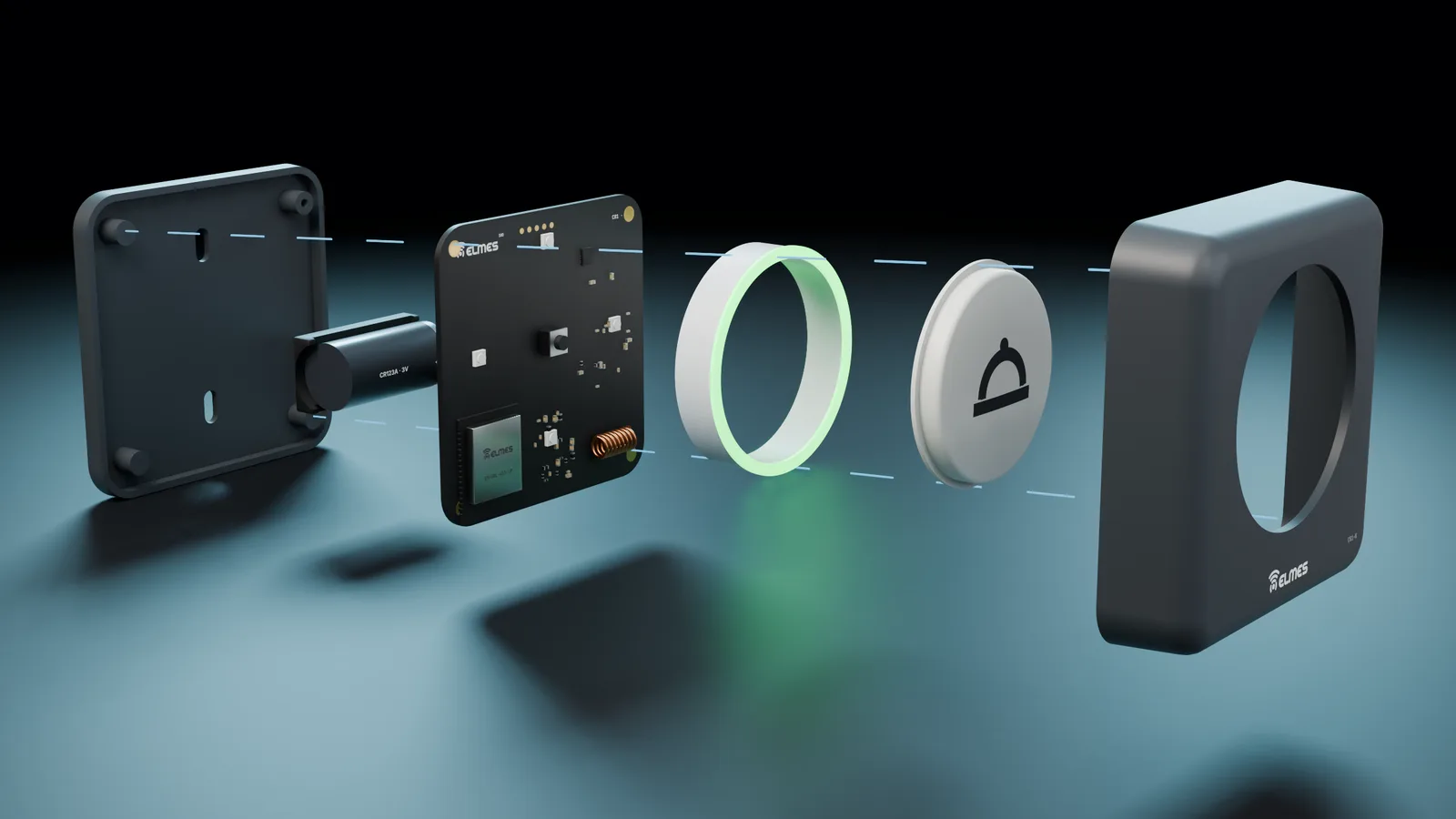
Wake-on-press design. The MCU and radio sleep until the button is pressed; periodic "I'm alive" packets let the central unit track battery and link status. Housing and labeling change with the application; the electronics stay the same.
This product is in development or field testing. Contact us for technical information, pilot use and a preliminary quotation.
Features
- Profile selection: waiter, taxi, guard, fire, forklift, panic and door profiles on the same hardware; set at the factory or with a service tool.
- "I'm alive" report: battery, temperature and RSSI feed a maintenance list at the central unit.
- Long / double press: extra meanings on a single key (emergency, cancel).
- External contact input: button transmitter for doors, barriers or machines; single-contact monitoring. For 8-input battery-powered monitoring, see the Wireless Digital I/O Link.
- Optional modules: buzzer, vibration, RFID (guard profile), IP65 housing, u.FL external antenna.
- TargetACK LED: the user sees on the button that the call was received (two-way LoRa).
- TargetReplay protection and AES: the button cannot be cloned.
- TargetTamper contact and supervision: in the fire and guard profiles.
- Target868 MHz version: for export markets.
Variants
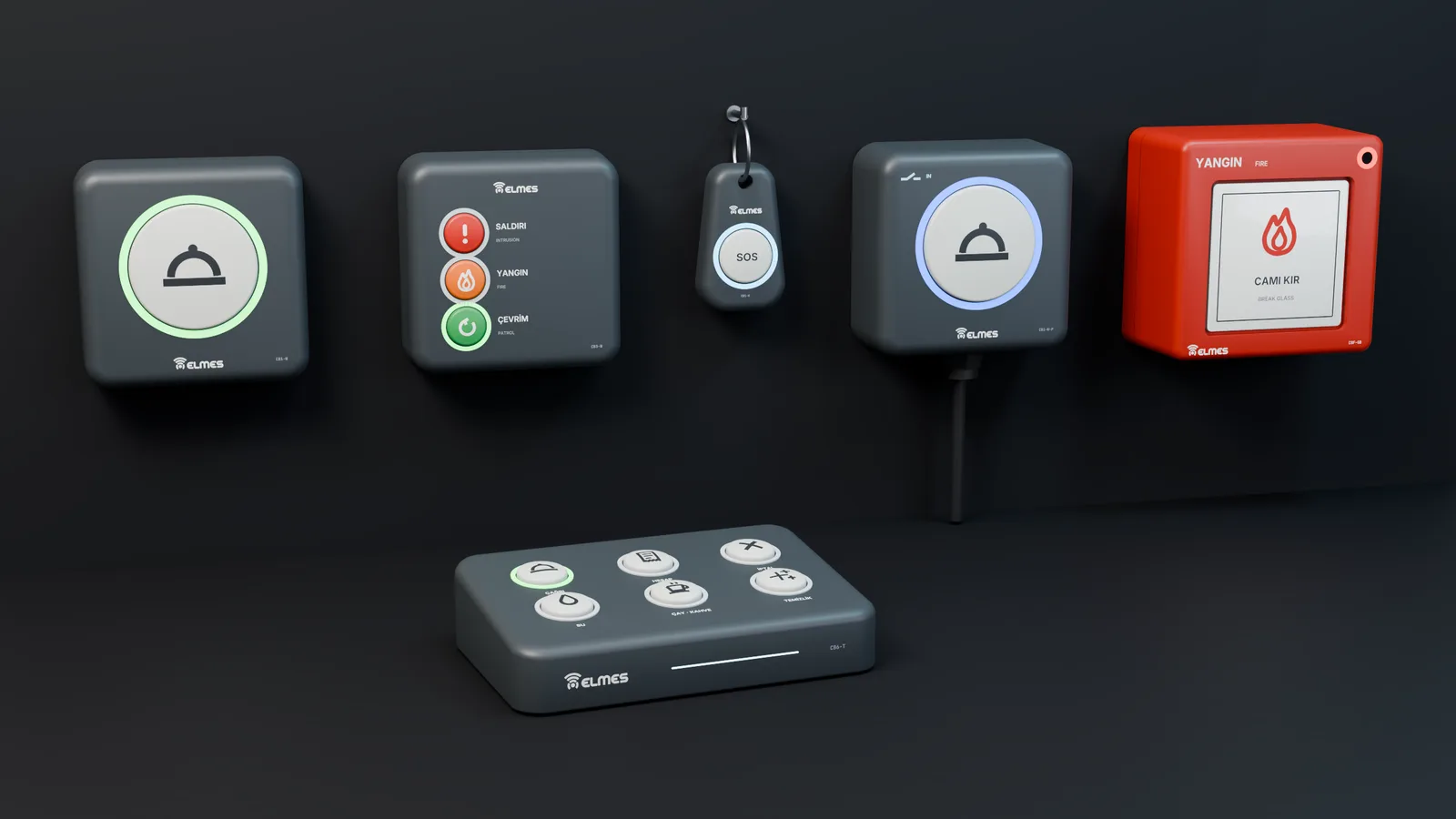
| Model code | Buttons | Housing | Battery | Profiles | Request information |
|---|---|---|---|---|---|
| CB1-W | 1 | Wall / table, IP54 | CR123A or 2×AA | Waiter, taxi, panic, forklift | Request information: CB1-W |
| CB1-K | 1 | Key fob / lanyard | CR2032 / CR123A | Panic, lone worker | Request information: CB1-K |
| CB3-W | 3 | Wall, IP54 | CR123A / 2×AA | Guard (attack / fire / patrol); taxi (call / cancel / emergency); waiter (waiter / bill / cancel) | Request information: CB3-W |
| CB6-T | 6 | Tabletop | 2×AA | Waiter / hotel (6 service types) | Request information: CB6-T |
| CBF-GB | 1 (break-glass / manual call point) | Red fire call point housing, IP54 / IP65 | Li-SOCl2 AA | Fire | Request information: CBF-GB |
| CB1-W-P | 1 + external input | Wall | Battery | Door / barrier button transmitter, machine call | Request information: CB1-W-P |
Specifications
Values marked “Target” are design targets, next-generation values or chip-vendor data; they are updated as measurement and certification are completed.
| Frequency band | 433.05–434.79 MHz, 8 channels (SX1268) |
|---|---|
| 868 MHz version | As an optionTarget |
| Output power | +22 dBm max.; profile default +14…+20 dBm (for battery life) |
| Receiver sensitivity | −129 dBm @ SF11 (chip datasheet) |
| Modulation / packet | LoRa SF7–SF12; short packet (≤ 16 bytes) |
| Antenna | Internal (PCB trace / helical); u.FL option in the IP65 outdoor housing |
| Open field | ≥ 1500 m (SF9, internal antenna, button at 1.2 m wall height, central outdoor omni antenna at 3 m)Target |
|---|---|
| Indoors | ≥ 150 m / 3 floors (hotel)Target |
| Encryption / coding | AES-128-CCM + counter (replay protection), NetID + 16-bit addressTarget |
|---|---|
| Coding in previous-generation buttons | ID + CRC |
| Pairing | Learn mode on the receiver (press the button → add to list) or via a service tool; UID-basedTarget |
| Systems on the same site | ≥ 8 systems via 8 channels × NetIDTarget |
| Press → central unit | < 300 ms @ SF7–SF9Target |
|---|---|
| ACK → LED | < 1 sTarget |
| Retries | 3 attempts, random 50–300 ms back-off |
| Battery | CR123A (3 V, ~1500 mAh) or 2×AATarget |
|---|---|
| Break-glass and key-fob battery | Break-glass: Li-SOCl2 AA; key fob: CR2032 |
| Consumption | Press event ~120 mA × ~100 ms; 2 "I'm alive" packets a day |
| Sleep current | < 10 µATarget |
| Battery life | ≥ 2 years at 20 presses/day (CR123A); ≥ 5 years in the fire profile (rare presses); estimated with the SDK calculatorTarget |
| Low-battery threshold | 2.7 V (CR123A); reported to the central unit |
| Keys | 1 / 3 / 6 mechanical keys; break-glass: glass/plastic plate + micro switch; long press 1.5 s, double press |
|---|---|
| Indicators | 1× RGB LED (sent / ACK / error / battery); buzzer (optional, per profile) |
| External input | 1× dry contact (CB1-W-P: door / barrier / machine) |
| Tamper contact | 1× tamper inputTarget |
| Service | SWD pads; UART (programming fixture) |
| Housing dimensions | Wall 1/3 keys ~80 × 80 × 25 mm; table 6 keys ~120 × 80 × 30 mmTarget |
|---|---|
| Other housings | Key fob; standard red fire call point housing for break-glass |
| Ingress protection | IP54 (indoor / semi-outdoor); IP65 (outdoor, outdoor break-glass)Target |
| Mounting | Screws / double-sided tape / lanyard |
| Operating temperature | −20…+60 °C (depends on battery chemistry; −40…+85 °C with Li-SOCl2)Target |
| Warranty | 2 years; battery is a consumableTarget |
|---|
Applications
- Waiter and service calls
- Taxi stand subscribers
- Facility guard posts
- Industrial fire call points
- Forklift and operator calls
- Line-stop notification
- Panic / lone worker
- Door and barrier transmitter
Each profile works with the receiver or central unit of the related product:
- Hotels, restaurants and beaches: waiter and service calls — Wireless Waiter Call — Long Range
- Taxi stand subscribers: Wireless Taxi Call System
- Guard posts: attack / fire / patrol — Wireless Guard Patrol System
- Industrial fire: manual call point / break-glass — Wireless Fire Alarm System (Firesens)
- Doors and barriers: remote button transmitter — Smart Door Control & Access
- Factories and warehouses: forklift and operator calls, line stops; panic buttons for security staff and night guards
On the pager side, the WR-001 LoRa Wireless Alarm / Call Remote can show and acknowledge the call in the staff member's pocket. Field users of the waiter call application are listed on that product's page.
Compliance & documentation
The platform is at prototype stage. The datasheet, profile guides, pairing/installation card and certificates will be prepared according to the plan below.
- TargetCE – RED 2014/53/EU (EN 300 220-2, EN 301 489-1/-3)Step by step, starting at module level
- TargetEN 62368-1
- TargetRoHS declaration
- TargetEN 54-11 (manual call point) / EN 54-25 (radio components) — fire profileTogether with the certification of the Wireless Fire Alarm System (Firesens)
- TargetBattery safety and transport documents
- TargetCE declaration of conformity
Frequently asked questions
Can I use the same button for waiter and taxi calls?
Yes; the hardware is the same, only the profile and label differ. The receiver side depends on the application.
When I press, will I see that my call was received?
With the targeted two-way operation, yes: the LED turns green when the acknowledgment arrives and red if it does not — press again or check the range.
How long does the battery last?
The target is ≥ 2 years with a CR123A at 20 presses a day and ≥ 5 years in the fire profile. Low batteries show up at the central unit.
What is the range?
It is a battery-powered device with an internal antenna, so the link budget is gained at the central antenna. The targets are ≥ 1.5 km in open field and 3 floors inside a hotel; a repeater extends it.
Will two systems in the same building (hotel + restaurant) interfere?
No; channel and network ID (NetID) are kept separate. With the targeted AES encryption, packets from another system are not processed.
Can a button be cloned?
Not in the target design: it uses AES-128 encryption and a replay counter.
Does it work with my previous-generation receiver?
It does not work with previous-generation (CC1101-based) receivers. Compatibility with taxi stand buttons is covered on the Wireless Taxi Call System page.
Is it certified as a fire call point?
Not yet. EN 54-11 and EN 54-25 certification is targeted together with the Wireless Fire Alarm System (Firesens); it is not called "fire certified" until the documents are in hand.
What about the warranty?
A 2-year warranty is planned; the battery is a consumable.
Get information about this product
Our engineering team replies within 24 hours.
Related products
 RF & Wireless Systems
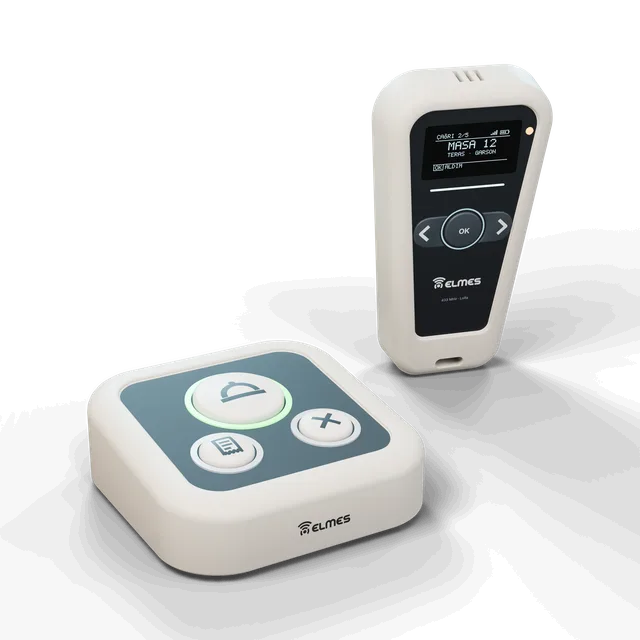
Wireless Waiter Call — Long Range
From hotel interiors to the beach — simple, fast calls.
View details: Wireless Waiter Call — Long Range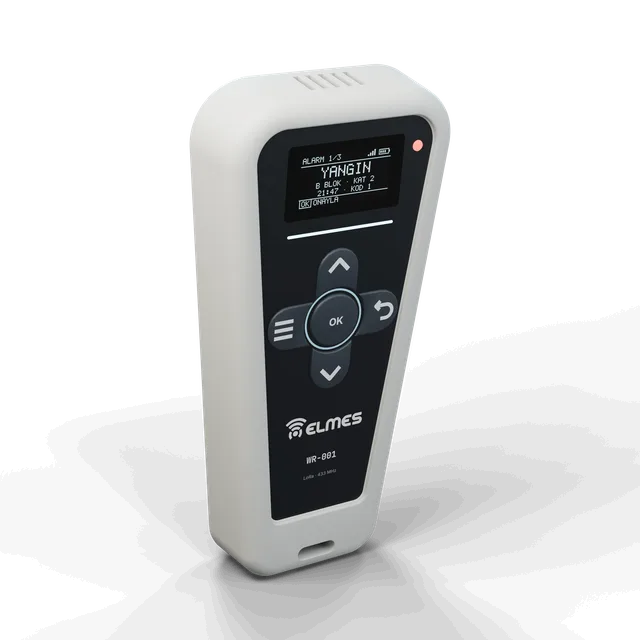 Coming soonRF & Wireless Systems
WR-001 LoRa Wireless Alarm / Call Pager
The alarm in your pocket — everyone sees who acknowledged it.
View details: WR-001 LoRa Wireless Alarm / Call Pager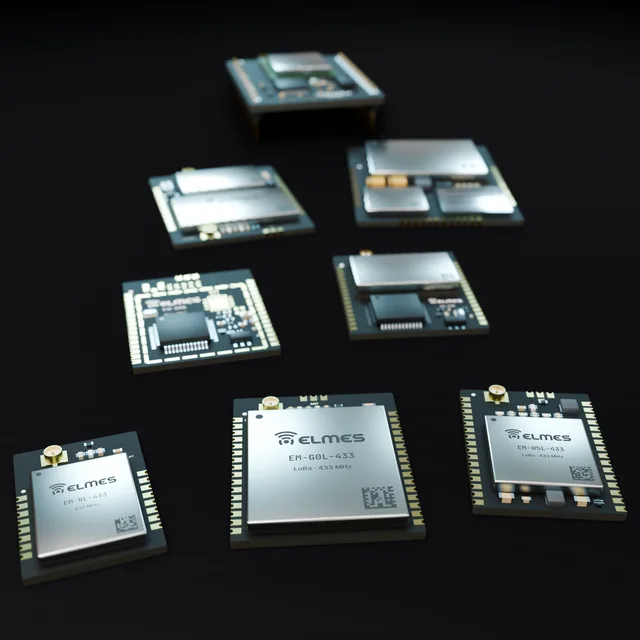 Coming soonModules, Boards & Gateways
Elmes EM Module Series
One pinout, one SDK — LoRa, Wi-Fi and cellular in a single module family.
6 members
View details: Elmes EM Module Series