Modules, Boards & Gateways · Hardware
Radio-only LoRa Module (EM-NL-433)
A measured LoRa radio path, connected to the MCU of your choice over SPI.
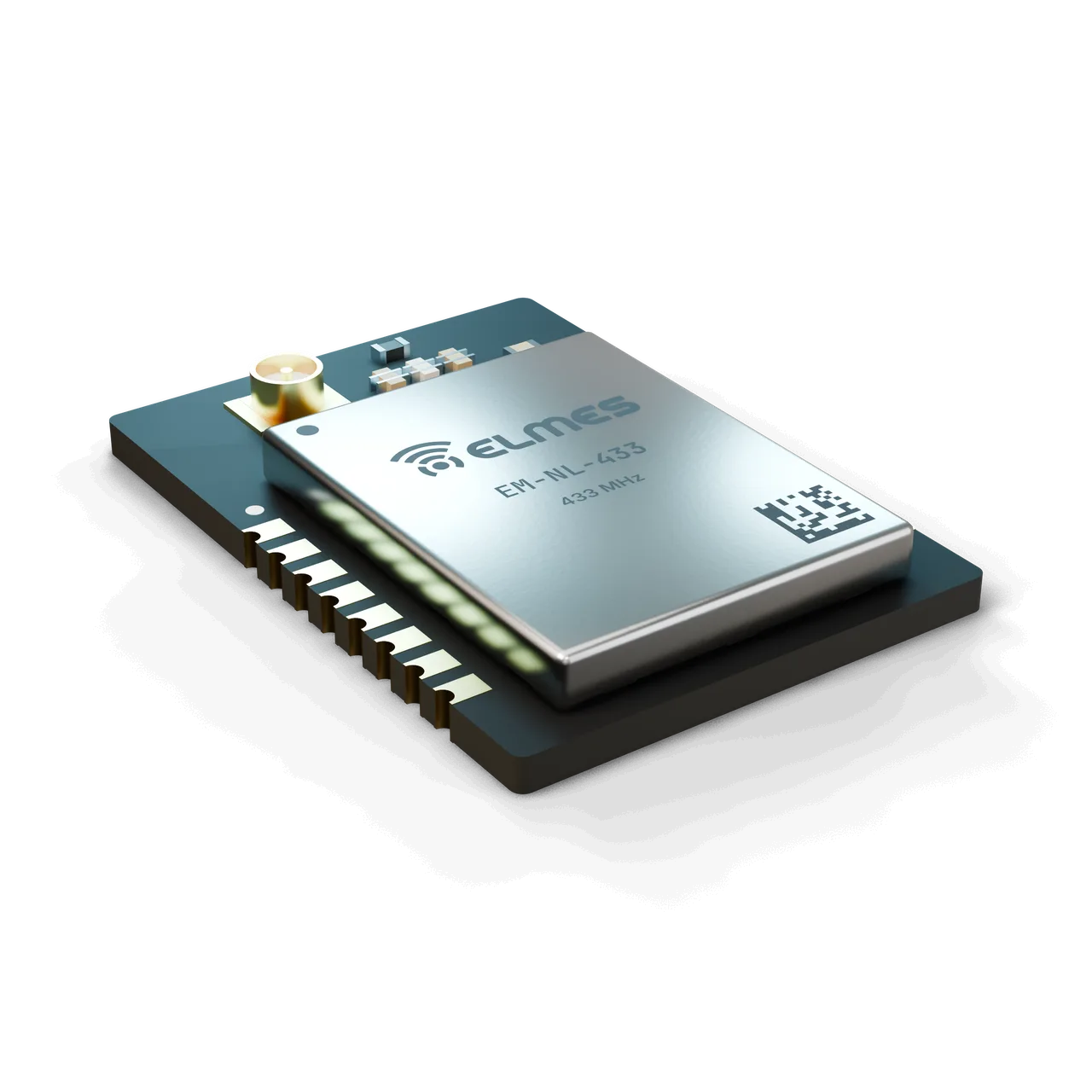
Overview
The problem. Some Elmes products (crane receivers/transmitters, the RT152 data transmitter family) already have an MCU that is not going to change; all they need is a LoRa radio. Today that gap is filled by imported off-the-shelf radio modules: single source, closed design, pinouts that change between revisions and no documentation in Turkish. Designing around a bare SX1268 instead means repeating the matching network and measurements for every product.
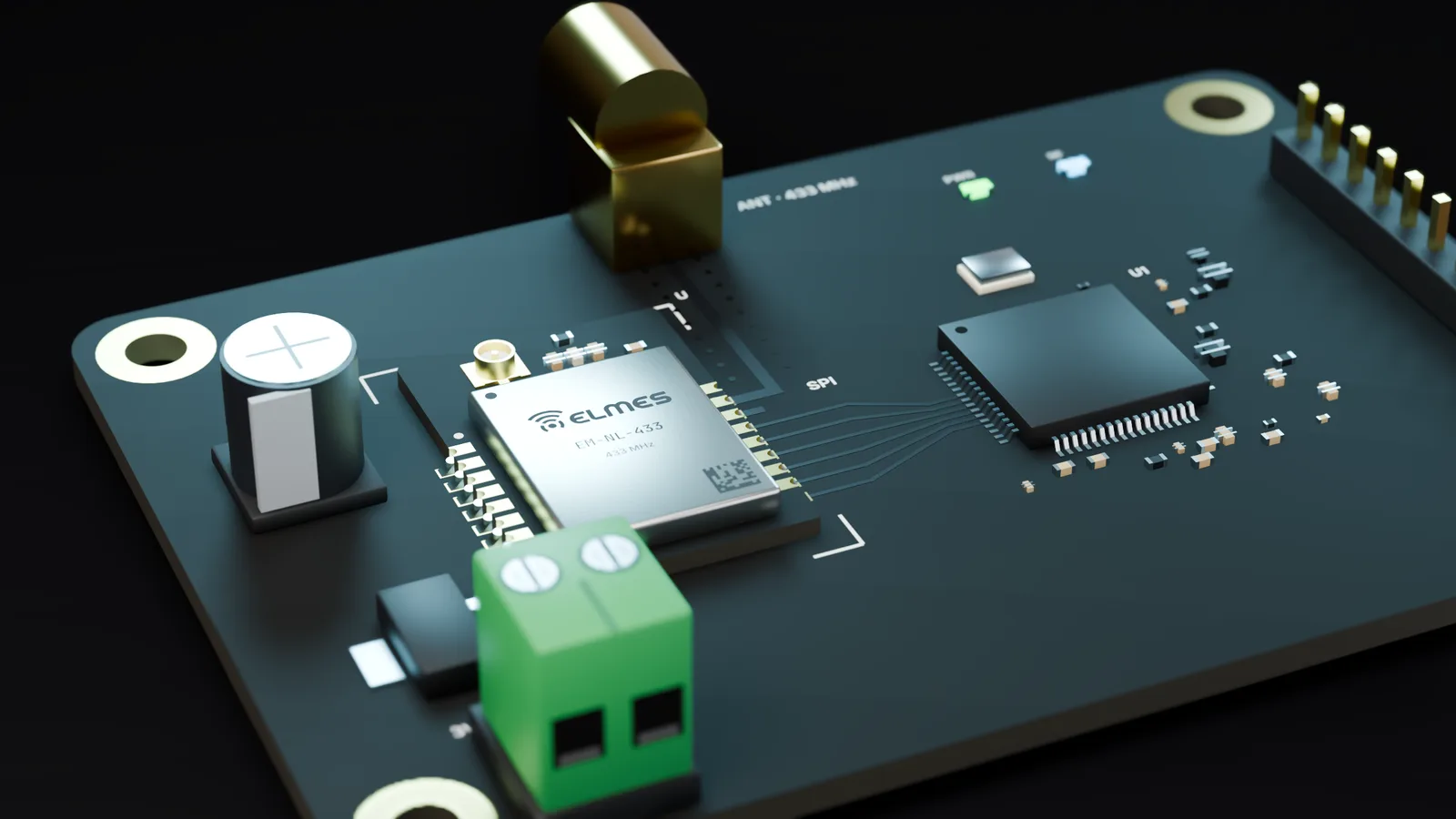
The solution. EM-NL-433 takes the radio section of the EM-G0L-433 module and makes it a separate castellated module: SX1268 + 32 MHz TCXO + RF switch (controlled by DIO2) + matching and harmonic filter + u.FL/antenna pin. The interface is plain SPI + BUSY/DIO1/NRESET with 3.3 V logic. The driver is open and platform-independent.
Variants. The same PCB takes LLCC68 (EM-NK-433) and SX1262 (868/915 MHz) versions. In Elmes products it replaces the imported off-the-shelf module; for other manufacturers it offers a “take the radio, keep your MCU” option.
This product is in development or field testing. Contact us for technical information, pilot use and a preliminary quotation.
Features
- Shared RF design: the same radio path as EM-G0L-433; 868 MHz (SX1262) and LLCC68 versions with a single validation and a single BOM change.
- Driver support: common SX126x/LLCC68 API; the host HAL needs only 5 functions.
- On-module TCXO and DC-DC: no crystal or regulator needed on the host side.
- Production test: RF power and frequency measurement on the programming/test fixture; no host MCU needed, the fixture drives SPI directly.
- TargetHost examples: example projects for STM32, ESP32 and PIC24 (RT152 migration).
- TargetSeparate TX/RX pins: pads reserved to replace the RF switch in a future high-power PA version.
- TargetPortable protocol core: the host MCU joins the EM network (same NetID/addressing as EM-G0L-433 nodes).
Variants
| Model code | Radio | Band | Note | Request information |
|---|---|---|---|---|
| EM-NL-433 | SX1268 | 433 MHz | Main member | Request information: EM-NL-433 |
| EM-NK-433 | LLCC68 | 433 MHz | Low-cost version | Request information: EM-NK-433 |
| EM-NL-868 / -915 | SX1262 | 868 / 915 MHz | Band variant | Request information: EM-NL-868 / -915 |
Specifications
Values marked “Target” are design targets, next-generation values or chip-vendor data; they are updated as measurement and certification are completed.
| Frequency band | 410–525 MHz (SX1268); Elmes channel plan 433.05–434.79 MHz |
|---|---|
| Channels | 8 (same as EM-G0L-433); the host can define its own channel plan |
| Output power | +22 dBm (SX1268 PA), adjustable −9…+22 dBm |
| Receiver sensitivity | −129 dBm @ SF11/BW125 (chip datasheet) |
| Modulation | LoRa SF5–SF12, (G)FSK |
| Data rate | LoRa 0.018–62.5 kbps; FSK 300 kbps |
| Frequency reference | 32 MHz TCXO (powered from DIO3) |
| TCXO stability | ±2 ppm class (depending on part selection)Target |
| Antenna connection | u.FL and antenna pin, 50 Ω; selected with a 0 Ω jumper or as a build option |
| Host interface | SPI (≤ 16 MHz), NSS, BUSY, DIO1 (IRQ), NRESET; 3.3 V logic; DIO2 (RF switch) on the module |
|---|---|
| Reserved pads | DIO2 output, TXEN/RXEN (for a future PA version)Target |
| Open field | ≥ 2000 m (SF9, 2 dBi dipole, 2 m height) — same test as EM-G0L-433Target |
|---|---|
| Industrial / indoor | ≥ 300 mTarget |
| Encryption / addressing | In the host protocol; AES-128-CCM, NetID + 16-bit address with the portable EM-SDK coreTarget |
|---|---|
| Systems on the same site | ≥ 8 (channel × NetID, host protocol)Target |
| TX start-up (sleep → RF) | < 5 ms class (TCXO + PLL; from chip datasheet values)Target |
|---|---|
| Fail-safe on link loss | Defined by the host application |
| Supply | 3.0–3.6 V; DC-DC (internal) or LDO mode, selected in the driver |
|---|---|
| Consumption TX / RX / sleep | ~118 mA @ 22 dBm / ~5 mA (DC-DC) / < 1 µA (sleep, TCXO off) — chip datasheet |
| Pad count / pitch | 2×8 castellated, 1.27 mm (edge aligned with EM-G0L-433): VCC, GND×3, SCK, MISO, MOSI, NSS, BUSY, DIO1, NRESET, ANT + 4 reserved pads |
|---|---|
| Dimensions | ≤ 14 × 20 mmTarget |
| Mounting | Castellated SMD; keep-out area on the antenna side |
| Operating / storage temperature | −40…+85 °C / −40…+105 °CTarget |
| Humidity | 5–95 %, non-condensing |
| Warranty | 2 yearsTarget |
|---|---|
| Spare-parts support | 5 years |
| Production | Ankara |
Applications
- Adding LoRa to an existing MCU
- Crane receiver/transmitter boards
- Analog/digital data transmitters
- ESP32, RP2040, PIC designs
- Split-architecture control systems
- 868/915 MHz export products
In Elmes products. The same radio design as EM-G0L-433 and EM-G0LW-433; split-architecture versions of the Wireless Crane Control receiver/transmitter and of the RT152 family of the Wireless Analog & Digital Data Transmitter (PIC24 host); a second-revision option for MOD-M0 (the EM-NL-433 RF section in place of the off-the-shelf radio module).
External sales. Integrators with their own MCU (ESP32, RP2040, PIC, other STM32 families) and 868/915 MHz export products (EM-NL-868 / -915).
Compliance & documentation
In the first phase it is supplied with the note “OEM integrator responsibility”; no module-level certificate has been issued yet. It is the second module in line for certification, after EM-G0L-433.
- Out of scopeEnd-product CE/RED conformityOEM integrator responsibility in the first phase
- TargetCE – RED 2014/53/EU: EN 300 220-2 (radio), EN 301 489-1/-3 (EMC)If the radio-only module is certified, antenna/gain and supply conditions are fixed in the certificate; derivative products that meet these conditions do not repeat the radio tests (subject to an accredited lab's opinion).
- TargetRoHS / REACH declaration
- TargetEM-NL-868 / -915: separate EN 300 220 testing
Frequently asked questions
Is it a drop-in replacement for the off-the-shelf radio module I use (e.g. DRF1268T)?
No; footprint compatibility was not a design goal. New board designs use the EM-NL-433 footprint.
Which MCUs does it work with?
Any MCU with SPI; the driver is written in C and is platform-independent. STM32, ESP32 and PIC24 examples are planned.
Does the module have firmware?
No; the host MCU drives the radio IC. The driver and protocol core are open (EM-SDK Open, Apache-2.0 planned).
Can it work in the same network as EM-G0L-433 nodes?
Yes, if the host runs the EM protocol core (same NetID, addressing and encryption).
Is there an 868 MHz version?
Yes, the SX1262-based EM-NL-868 on the same PCB; the ETSI duty-cycle rules are in the SDK.
Is there a lower-cost version?
EM-NK-433 (LLCC68): no SF12; apart from the longest SF, the range is the same.
Can I increase the output power?
The maximum is +22 dBm (SX1268). Reserving TXEN/RXEN pads for an external PA is under consideration.
Does it have CE/RED certification?
Certification is being done in phases; the radio-only certificate is planned so that it can carry over to derivative products. In the first phase it is supplied under OEM integrator responsibility.
Get information about this product
Our engineering team replies within 24 hours.
Related products
 RF & Wireless Systems
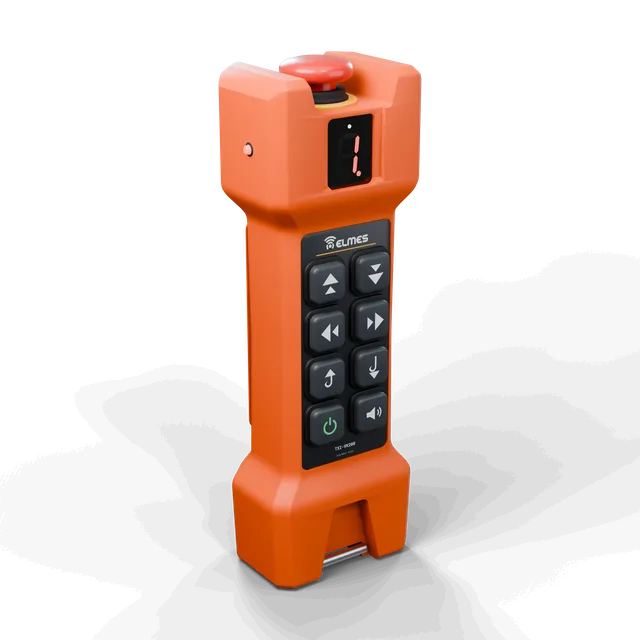
Wireless Crane Control System
Encrypted RF link, millions of operations in the field.
View details: Wireless Crane Control System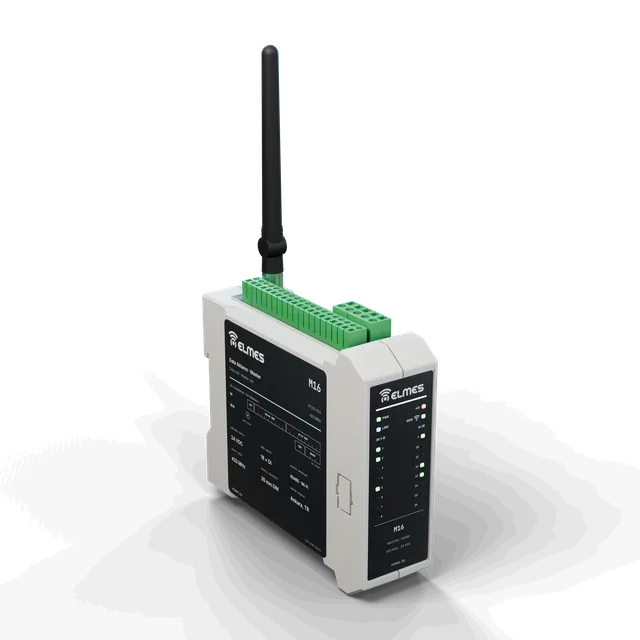 RF & Wireless Systems
Wireless Analog & Digital Data Link
Carry 4–20 mA / 0–10 V signals wirelessly.
View details: Wireless Analog & Digital Data Link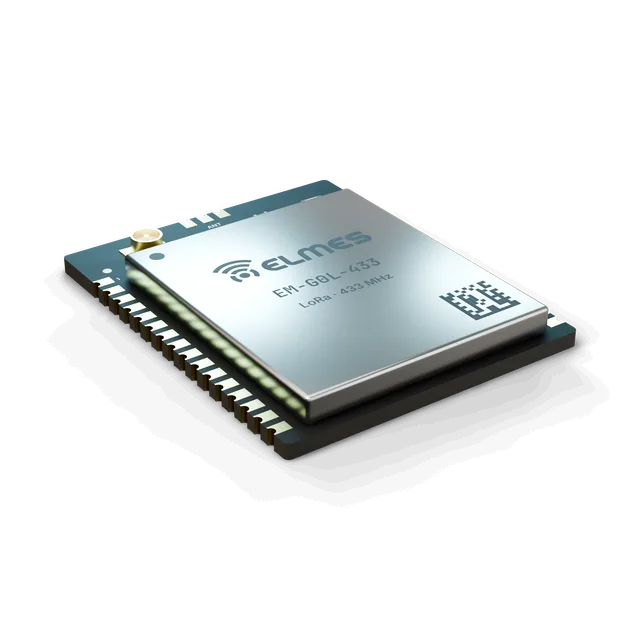 Coming soonModules, Boards & Gateways
STM32 + SX1268 LoRa Module (EM-G0L-433)
A field-proven LoRa path in a castellated module.
View details: STM32 + SX1268 LoRa Module (EM-G0L-433)